
Making the minimum payment keeps you meeting that bill’s required payment, but it can leave a revolving balance around for years. Interest and new purchases may absorb much of what you send.
The fastest useful check is on your own statement: compare your payment with the interest charged and the purchases added. If the balance hardly moves, you need to know which part is holding it up.
Follow one month of money
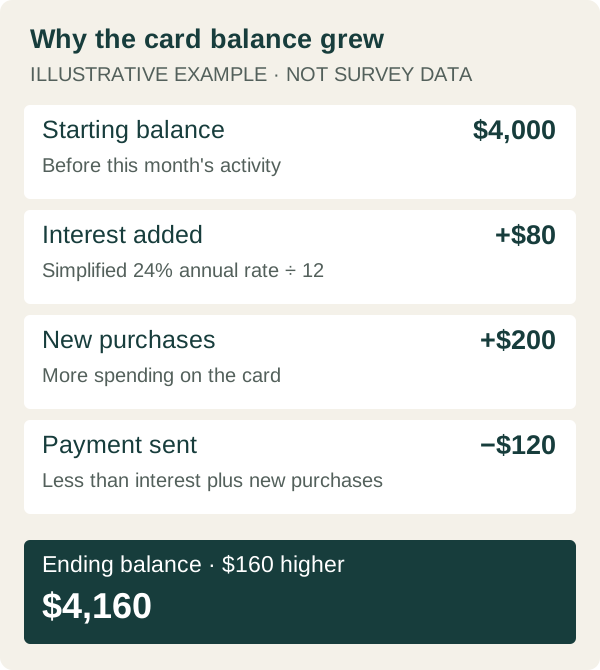
Consider an illustrative $4,000 balance at a 24% annual rate. Using a simplified monthly rate of 2%, one month’s interest is about $80. Real cards often calculate interest using daily balances, so your statement can differ.
If you pay $120 and make no new purchases, roughly $40 reduces the balance in that simplified month. If you also charge $200, the balance ends around $4,160 instead:
$4,000 + $80 interest + $200 purchases − $120 payment = $4,160.
You paid on time, but your debt grew. A larger payment alone may not solve the problem if ordinary spending keeps returning to the card.
What the payoff box tells you
Statements commonly show how long minimum-only repayment would take and an amount intended to repay the balance in three years. The CFPB explains that the three-year estimate assumes no new purchases.
The minimum is still the amount due; the three-year figure shows what it would take to finish sooner, and it stops being accurate once you add purchases.
Find these four items:
- Current balance and the different APRs that apply.
- Minimum due and due date.
- Interest and fees charged this cycle.
- Minimum-only and three-year repayment disclosures, where provided.
A card can carry purchase, transfer, and cash-advance balances at different rates. When you pay more than the minimum, the CFPB notes that the issuer generally must apply the extra to the balance with the highest interest rate.
Choose a payment that can stay in place
If you can afford more than the minimum, set a target above it that you can pay every month without causing an overdraft or needing a cash advance before payday.
In our simplified example, a $250 payment with no new purchases reduces the balance by about $170 in the first month, more than four times the $40 from a $120 payment. If that larger payment forces $200 of groceries back onto the card, the balance still rises by about $30.
Build those groceries into the checking-account budget. If removing new charges reveals a shortfall, address that shortfall alongside repayment.
If you have several cards, pick a target
Keep required payments current on all accounts you can afford, then direct extra money deliberately. Targeting the highest rate generally reduces interest cost; targeting the smallest balance may help you maintain momentum.
Use the payoff-order guide to compare the trade-offs. Spreading a little extra across every card can make progress harder to see, though the total still matters.
If you are struggling to make the minimum, contact the issuer about assistance promptly. Ask about the rate, payment, fees, length of any arrangement, and how the account will be treated. Do not assume missing a payment is necessary to request help.
A transfer is useful only with an exit plan
A lower promotional rate can help, but the CFPB lists the costs to check. A balance transfer fee is usually a percentage of the amount moved or a fixed amount, whichever is more. The promotional rate lasts a limited time, and the rate afterward may rise.
The CFPB warns that new purchases on the transfer card get no grace period, so they collect interest until the entire balance is paid in full. Keep everyday spending on a different card or on debit.
Work out whether your planned payments can clear the transferred balance before the offer ends. The CFPB also notes that many people do not get out of debt by taking on more debt unless they lower their spending, so the spending plan has to come with the transfer.
Before your next due date, write down your payment target, how you will fund routine purchases without adding to this balance, and the date you will check progress.
Sources checked October 5, 2026. All worked examples are illustrative, not survey estimates. General financial education, not individualized financial advice.