
A $15,000 down payment does not mean you need only $15,000 to buy the home. Closing costs and prepaid expenses add to the purchase cash, while deposits and credits can reduce what remains due at signing.
You also need money after closing for moving, repairs, and emergency savings, and none of it appears on the lender’s cash-to-close line.
Understand the number on the Loan Estimate
The CFPB’s Loan Estimate explainer describes estimated cash to close as the down payment and closing costs, adjusted for money already paid, credits, and other items.
Use the form for the specific loan rather than adding a generic closing-cost percentage to a price. Ask the lender to explain any line you do not recognize.
A simplified example:
| Transaction item | Amount |
|---|---|
| Down payment | $15,000 |
| Closing costs and prepaid items | +$8,000 |
| Deposit already paid and credited at closing | −$3,000 |
| Seller credit permitted for this transaction | −$2,000 |
| Remaining cash to close | $18,000 |
Other adjustments, such as property taxes the seller has already paid for part of the year, can also change the final figure. The $3,000 deposit is your own money, paid earlier and credited at closing. Total buyer cash in this simplified transaction is $21,000: the deposit plus the remaining amount.
Do not add the deposit twice when estimating the final transfer.
Know why some closing items are not fees
Closing costs can include charges for getting the loan and transferring ownership. The disclosure also shows prepaid items and the initial escrow deposit.
Prepaid insurance, prepaid interest, and an escrow deposit pay for your own upcoming bills, while an origination fee is the lender’s charge for making the loan. Separate those categories when comparing lenders so you know which difference reflects a loan charge and which reflects an estimate or timing.
A lender credit can offset upfront costs, sometimes in exchange for a higher interest rate. A seller credit is subject to the agreement and financing rules. Ask what you can actually use it for.
Which estimates can still change
The CFPB explains which costs can change between the Loan Estimate and closing. Fees paid to the lender or mortgage broker, fees for required services you were not allowed to shop for, and transfer taxes generally cannot increase. Recording fees and required services from a provider on the lender’s written list can increase by up to 10 percent in total. Prepaid interest, homeowners insurance premiums, and the initial escrow deposit can change by any amount.
Those limits apply unless something changes in the application. A lapsed rate lock, a different appraisal value, a change in your credit, or income that cannot be documented can lead to a revised Loan Estimate.
Compare the final disclosure with the estimate
The lender must give you the Closing Disclosure three business days before your scheduled closing. Use those days to compare loan terms, total monthly payment, closing costs, credits, and cash to close with the most recent estimate.
Resolve any unexplained difference before signing, even if the moving truck is booked. Ask the lender or closing professional what changed and why.
Also check expenses that are not escrowed. If you must pay taxes, insurance, or association charges separately, put them into the ongoing budget.
Add a second budget for the first months
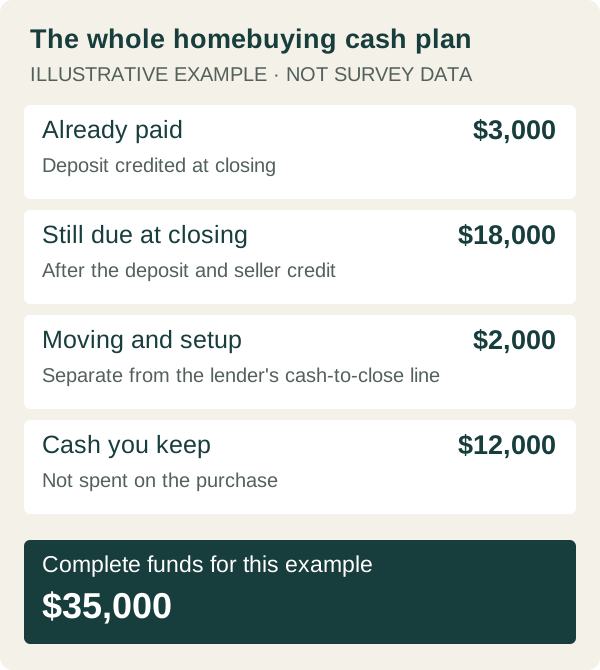
Suppose you also expect $2,000 of moving and setup costs and want to retain $12,000 of emergency cash. In the example, you need $35,000 in total funds across the whole plan:
$3,000 already deposited + $18,000 remaining at closing + $2,000 setup + $12,000 retained.
If the deposit is already paid, the remaining funds needed for closing, setup, and the reserve total $32,000.
Make room for utilities, essential appliances, and repairs identified before purchase.
Verify how the closing money must be delivered
Ask the closing professional about acceptable payment, documentation, and timing. Scammers send fake emails that look like they come from a real agent or settlement company, with new wiring instructions.
The CFPB’s closing-scam guidance is to pick two trusted contacts early and record their phone numbers. Before wiring money, call one of them at that number, never a number from an email, to confirm the instructions. Do not send financial information by email. If you think a wire went to the wrong place, call your bank or wire service immediately to ask for a recall, then file a complaint with the FBI’s Internet Crime Complaint Center at ic3.gov.
Gift funds, assistance, or money moved between accounts can require documentation. Tell the lender about the source early rather than assuming any available balance will qualify.
Set the savings target with two lines: cash needed to buy and cash needed to stay secure afterward.
Sources checked October 5, 2026. All worked examples are illustrative, not survey estimates. General financial education, not individualized financial advice.